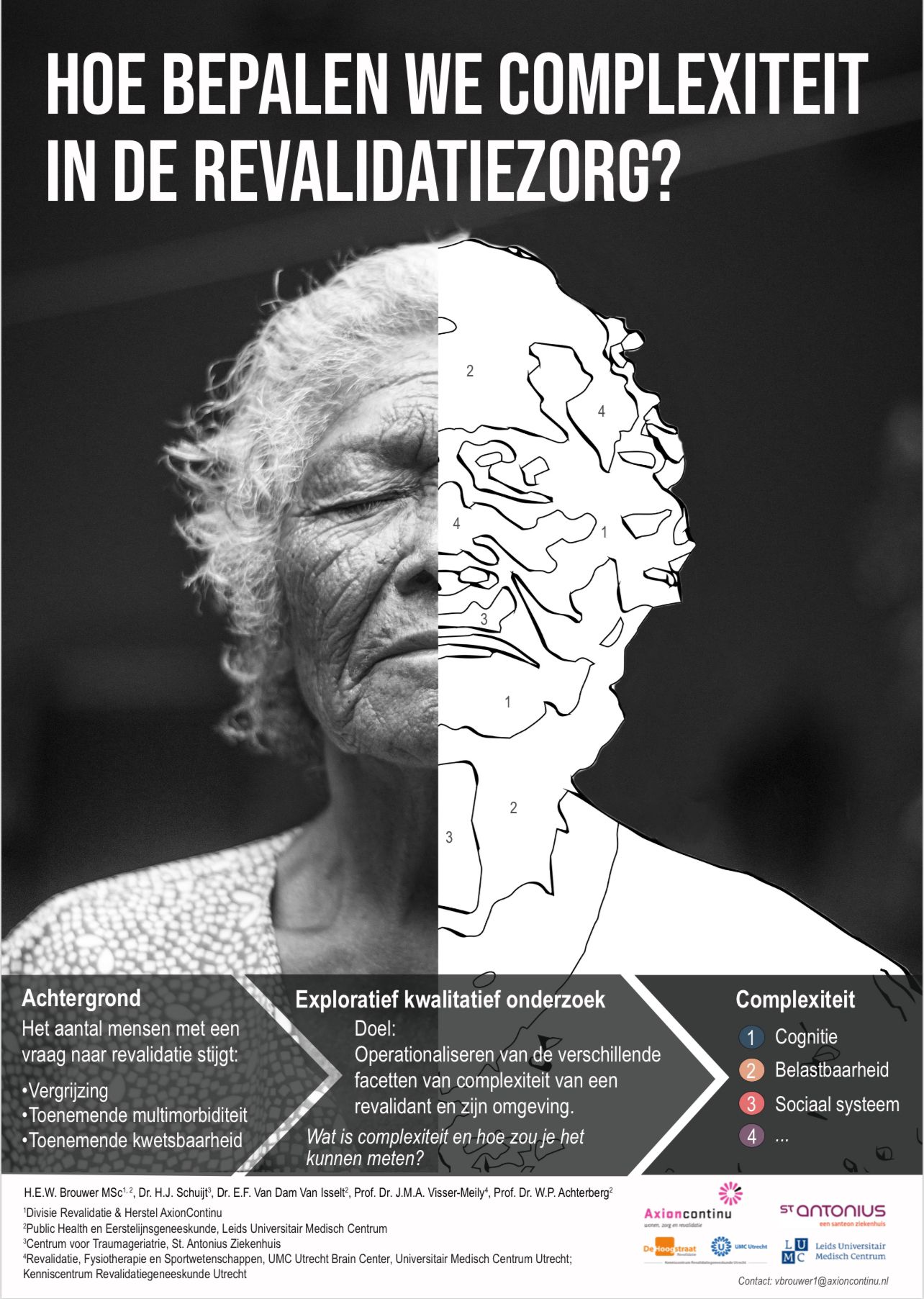
Complexiteit in de geriatrische revalidatie

English text below

In de geriatrische revalidatie wordt herstel niet alleen bepaald door de medische aandoening of functionele beperkingen, maar ook door persoonlijke en omgevingsfactoren. Denk bijvoorbeeld aan motivatie, ziekte-inzicht, coping, sociale steun, mantelzorgbelasting en de thuissituatie. In dit onderzoek brengen we in kaart hoe deze factoren bijdragen aan complexiteit in de geriatrische revalidatie en hoe zorgprofessionals hiermee omgaan in de praktijk.

Inhoud onderzoek

De geriatrische revalidatie draait niet alleen om de medische aandoening of functionele beperkingen. Psychische, sociale -en omgevingsfactoren een belangrijke rol spelen in het herstelproces. Deze factoren beïnvloeden niet alleen de revalidatie-uitkomsten, maar ook de behandelplanning, besluitvorming en de samenwerking tussen zorgprofessionals. Dit promotieonderzoek richt zich op het beter begrijpen, beschrijven en duiden van complexiteit in de geriatrische revalidatie. Hierbij wordt gebruikgemaakt van het International Classification of Functioning, Disability and Health (ICF)-model als raamwerk om functioneren en herstel vanuit een breed perspectief te bekijken.

Systematische literatuurstudie

In de eerste studie (2024) is een systematische literatuurstudie uitgevoerd naar factoren binnen het ICF-model die samenhangen met uitkomsten van geriatrische revalidatie. Het doel van deze studie was om inzicht te krijgen in welke lichaamsfuncties, activiteiten, participatie- en omgevingsfactoren in de literatuur in verband worden gebracht met revalidatie-uitkomsten bij ouderen.

Studie met praktijkdata bij revalidanten met COPD

In de tweede studie (2025) is gebruikgemaakt van bestaande praktijkdata van revalidanten met COPD in de geriatrische revalidatie. Hierbij is onderzocht welke klinische en psychosociale factoren samenhangen met ziekte-gerelateerde gezondheidsuitkomsten.

Kwalitatieve interviewstudie

De derde studie (nu in uitvoering) richt zich op de ervaringen van specialisten ouderengeneeskunde met complexiteit in de geriatrische revalidatie. Door middel van interviews door heel Nederland wordt onderzocht hoe zij persoonlijke en omgevingsfactoren herkennen, welke factoren zij hierbij meewegen en hoe deze factoren een rol spelen in behandelplanning en besluitvorming. Ook wordt verkend welke uitdagingen en afwegingen zij tegenkomen in de dagelijkse praktijk.

Het doel van studies die hier op volgen en de bredere onderzoekslijn is om beter zichtbaar te maken wat complexiteit in de geriatrische revalidatie inhoudt om beter zichtbaar te maken wat complexiteit in de geriatrische revalidatie inhoudt en welke persoonlijke en omgevingsfactoren van invloed zijn op het revalidatieproces. Daarmee kan het onderzoek bijdragen aan zorg die beter aansluit bij de behoeften van de revalidant en aan een beter begrip van de psychosociale factoren die een rol kunnen spelen in het revalidatieproces.


Presentaties

  • Poster Verenso GRZ Congres 2024
  • Poster DCRM 2025 (top 10 posters) en CVA/NAH symposium 2025

Read this text in English:

Complexity in geriatric rehabilitation

Geriatric rehabilitation is not only about the medical condition or functional limitations. Psychological, social and environmental factors also play an important role in the recovery process. These factors influence not only rehabilitation outcomes, but also treatment planning, decision-making and collaboration between healthcare professionals.

This PhD project focuses on better understanding, describing and interpreting complexity in geriatric rehabilitation. The International Classification of Functioning, Disability and Health (ICF) model is used as a framework to examine functioning and recovery from a broad perspective.

Systematic literature review

In the first study (2024), a systematic literature review was conducted on factors within the ICF model that are associated with outcomes of geriatric rehabilitation. The aim of this study was to gain insight into which body functions, activities, participation and environmental factors have been linked in the literature to rehabilitation outcomes in older persons.

Study using routine practice data from patients with COPD

In the second study (2025), routine practice data from patients with COPD receiving geriatric rehabilitation were used. This study examined which clinical and psychosocial factors are associated with disease-related health outcomes.

Qualitative interview study

The third study, which is currently ongoing, focuses on the experiences of elderly care physicians with complexity in geriatric rehabilitation. Through interviews across the Netherlands, we examine how they recognise personal and environmental factors, which factors they take into account, and how these factors play a role in treatment planning and decision-making. The study also explores the challenges and considerations they encounter in daily practice.

The aim of the subsequent studies and the broader research line is to make complexity in geriatric rehabilitation more visible and to better understand which personal and environmental factors influence the rehabilitation process. In doing so, the research may contribute to care that is better aligned with the needs of the rehabilitation patient and to a better understanding of the psychosocial factors that may play a role in the rehabilitation process.


Presentations

  • Poster presentation, Verenso GRZ Congress 2024
  • Poster presentation, DCRM 2025, selected among the top 10 posters
  • Presentation/poster, Stroke/Acquired Brain Injury Symposium 2025